

Fire!
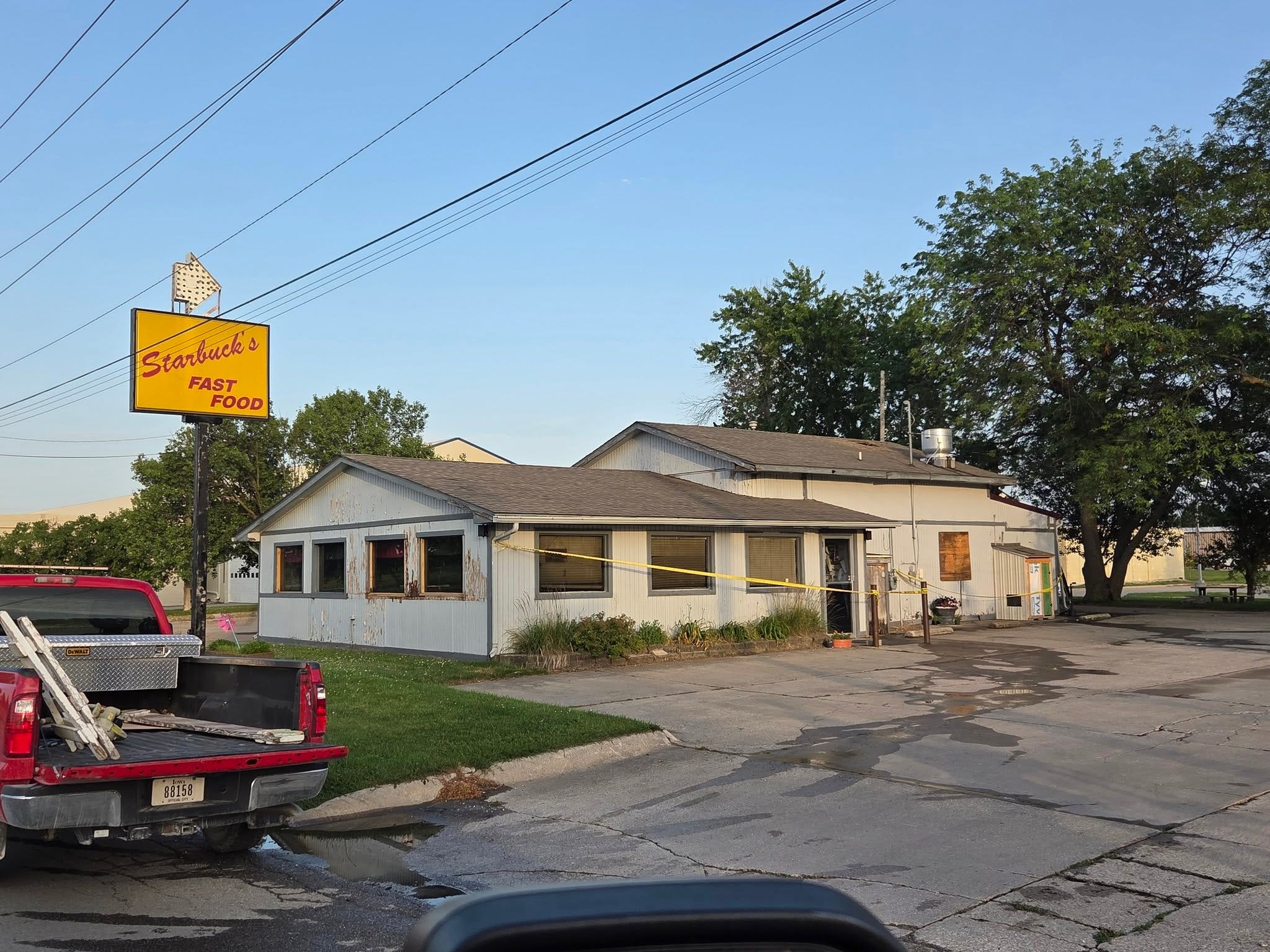
My hometown lost an icon last evening. A structure fire caused by an electrical overload destroyed a local icon and long-time community restaurant favorite known locally as the Starbucks Drive-In. No, not that Starbucks. This Starbucks was around for decades before the big Starbucks coffeehouse chain out of Washington state became a huge national phenomenon.
Here’s a post-incident photo posted by the local Nevada Fire Department. A link to their fire summary was here on Facebook but now seems to have limited viewing. Nevada is a small town in central Iowa, by the way.
The Unsettling
I’m posting this here because it strikes me how unsettling it is to lose icons.
Heck, here we are this week up in these United States celebrating (or something) 250 years of being a country, and the iconic things are all around us. The fireworks. The red, white, and blue. The patriotic swag. The flags. Soooooooo many flags. Images of bald eagles. The lists go on. We’re very big on our icons.
We get unsettled when we lose them. Or when they get messed up. Or devalued. Or defaced. Or razed. Or turned into green algae swamps when they were perfectly functional granite-surfaced reflecting pools.
We often get most unsettled when we lose them. Icons. Part of what makes a thing iconic is the very fact that we’d be unsettled if something happened to that thing or place or person.
Icons & The American Psyche
We are so fired up about icons that we — the United States — had national initiatives to specifically look after them in the years immediately after 9/11.
I know this because I was one of the people working in those programs (see my somewhat absurd and storied resume here). For a spell, it was my job to serve as the National Monuments & Icons Sector Specialist for the US Department of Homeland Security (DHS). The National Monuments & Icons sector was one of what were then designated as 18 critical infrastructure and key resources (CIKR) sectors. At some point since, that was all rearranged and simplified down to 16 critical infrastructure sectors (that link goes to a US government site) and the extra special care and feeding for the National Monuments & Icons key resources sector was abandoned. Or rather, left to the agencies, entities, and nonprofits that had been looking after monuments and icons already for decades or centuries.
In any case, for a while there after 9/11… some people somewhere determined that Americans were really very into their national icons and that should something bad happen to those icons… well we as Americans might not do very well with that so it was worth preventing… as much as such bad things could be prevented.
What kind of something bad?
Well, like if monuments or icons were, say, destroyed by a terrorist attack or burned down or razed as a result of an attack or blown up or something that otherwise changed how that iconic thing appeared, or how that iconic thing was available to Americans. This effect would, of course, be worse if people were hurt or killed in such attacks or damage.
The overall idea was that destruction to key national monuments and/or icons would cause a psychological blow to the American psyche, and that we would not take it well. Part of what terrorists want to do, after all, is to damage the American psyche. The American sense of well-being. And so on.
So the United States collectively put at least some effort into mitigating risks in this particular zone. For a while. I left that particular job before the critical infrastructure sectors were rearranged and the National Monuments & Icons key resources sector was cut from the list. As such, I’m not sure when the decision was made to spend less effort focusing on the specific risks to national monuments and icons at the federal level.
But at least some folks somewhere in these United States were convinced that monuments and icons were a very big deal to us. To Americans. To American culture. It was a thing.
I am not making this up. I went to a heck of a lot of meetings on this subject. I have classified information in my brain about this subject. Key players in this work at the time included: the US Department of the Interior (DOI), the National Park Service (NPS) within DOI, the Smithsonian Institution, the National Archives (where we keep the US Constitution, among other key artifacts and documents), state governments, and other federal agencies.
The thing is: it’s not nothing.
In this little tiny community of my hometown that lost an iconic restaurant last night, the shock is real. In this country when our national icons get changed or hurt or damaged, there are very real sort of shock-waves. There are effects. Sometimes depending on what has happened, there is actual shock, too.
Icons Are Iconic For Reasons
Icons help pull us together. They can be a unifying force. A thing in common. A symbol of who we perceive that we are. Sometimes they are gathering spaces.
In my case in this hometown restaurant… it’s where I remember going for ice cream on special summer nights as a kid. It’s one of the last places I went for dinner with a specific grandparent I used to pal around with. It’s a local place where we had a sort of spontaneous family reunion at the picnic tables out back when some family living in another state were driving through Iowa, and where the kids climbed trees while the adults got caught up on the kinds of thing you don’t get around to sharing when you don’t see people in the real world.
For people from my hometown, there will be thousands of stories like that shared over the next few days as word gets out about this iconic restaurant loss. As of this moment, the fire department Facebook post sharing this news already had 261 shares. That’s not a lot of shares for the bigger internet. It is a lot of shares — and fast — for a late-night post about a small-town incident. I imagine there will be thousands and thousands of shares over the next days as people spread the word to their friends and family with ties to the town.
It’s such a big deal that the restaurant already put out a statement on their social media that they’ll put out an official statement on Wednesday (today). The local fire chief has already had to advise folks that a citizen clean-up is not a good idea because the debris would be super toxic from this kind of fire. Community folks and people with ties who are now far away are already asking how they can help, and if a fund will be set up at a local bank or elsewhere to rebuild.
That’s one tiny town restaurant. To be fair, that place been open as a restaurant or ice cream place seasonally or in some form since the 1950s. Yet that’s part of how a thing becomes iconic: it sticks around for a really long time. It becomes part of the culture, or the community, or the symbology.
National Icons
Nationally, we’ve got a couple of big icon issues happening.
Okay I’m totally understating that. There are a lot of national icon issues happening.
I’m not going to try to summarize them here, because we are not a news organization, because we don’t have the resources to do a summary any justice, and because a giant list of national US icons undergoing big changes in the last year or two would totally make this into a different (and way longer) post.
Three high-visibility examples: the Reflecting Pool on the National Mall having been recently coated/painted blue in a paint job gone way wrong; the Kennedy Center being renamed and then being unrenamed and most recently being not yet untarped; and the razing of the East Wing of the White House. There are many, many more examples.
For what it’s worth, big changes that have been happening at national monuments and icons in the last year and a half do indeed seem to impact that national psyche. At least somewhat.
The failed coating work done to the Reflecting Pool on the National Mall that has turned to green algae has inspired a meme explosion that has well surpassed the volume of the pool’s new algae growth. The memes are priceless. They are also a way for people to process and grieve and share emotions. Because icons matter to people. They are part of the country’s culture and symbology.
It is indeed unsettling when big changes happen to the big icons. Just as much as when big changes happen to the little, hometown icons.
Icons are part of our landscape. Of our society. Of what we’ve come to expect. Of what we’ve gotten used to. They are symbols of our relative comfort and privilege, too, in some ways. Many American icons have up until now been symbols of a country and culture with enough stability that certain icons and monuments have endured. To make it through decades and sometimes much longer.
Changing the icons can cause us to feel unsettled. It can affect the psyche. Along with a zillion other things that are also affecting the psyche.
The Changes
Certain icons being forever changed is one thing. But what comes along with that is that they are forever changed. In many cases with these things, you can’t go back. A small-town restaurant can’t get un-burned. If something new gets built in its place, it will be a different something new.
What do we do with the other things that are changing permanently, or forever, or that are never going to be the same? We need to grieve. We need to feel all the feelings. That helps. There will be feelings.
A big piece of what’s next is admitting that things have changed. Part of getting to anything next is recognizing that an iconic thing has changed in some way, and that it isn’t going back.
It’s easier to get to next steps with whatever damage has happened if you’re able to admit that the thing has been damaged. It helps to get to the action plan. Or to thinking about what you as a society or community might actually want to do next with this space or this icon or this pile of rocks or this burned-out restaurant or whatever the damaged or changed icon is that you are dealing with.
To be fair, it may be the case that everyone has to just let the damaged or changed icons sit for a bit until big picture changes are made to get to something different, but that’s not always the case. Sometimes there are lots of options to explore. Also sometimes there are options to explore through official channels and formal bureaucracy… while at the same time there may be options for action that groups of people or communities can take on that don’t require going through a bureaucracy. It could depend on the moment, the location, the type of damage, or any number of other things.
One option for dealing with damage to icons we have valued… is to maybe imagine a world with different icons. After all, much as some Americans love love love the existing (or recently changed) monuments and icons… others are very well aware that many of those icons were built on colonized land, in problematic ways, by problematic people, for problematic reasons. Many of us gloss over some of that. We can get lost in the monumental-ness and iconography of it all, which is part of why we got monuments and icons to begin with. There’s a sort of pageantry and fancification that can happen that obscures some of the more violent or unequal or unjust or straight-up bigoted factors that played into what led to the iconic things in the first place. This country was not built by magical fairies using unicorns and pixie dust. It is a country with violent roots, deep betrayal, and structural inequality. In fact we built the structural inequality right into the base documents stored in a monumental building called the National Archives.
We’ve been evolving, since, and in many ways we’re getting better at a lot of this humanity stuff. We’re sometimes getting more inclusive. We’re sometimes taking better care of each other. We’ve sometimes gotten more rights. We’re also sometimes taking that stuff away and disappearing it.
Yet — just because some national monuments and icons are rooted in unhealthy, unjust, or otherwise unbalanced parts of US history is not a good reason to damage them or to write them off once they are ruined or altered or damaged. That they got damaged or changed is not a silver lining.
I’m unsettled, too, by some of the huge and breathtaking changes to national monuments and icons. Plus, recent changes to national icons are not being made out of concern for the national psyche, like in the post-9/11 world.
In fact, the reasons why there have been so many breathtaking and spectacular changes to national icons are very complicated and worthy of separate discussions by other folks. Understanding why may be helpful for some, but it isn’t the focus here. The point here is to say that there are effects. Huge big changes to national monuments and icons are having real effects on Americans, on communities, on the American psyche, and even on the perception of the United States by people and countries all over the world.
In the midst of all that, figuring out what we can do when so many iconic things around us are being changed so quickly can help us better navigate what’s happening.
Forward From Here
Whatever is happening with these iconic things — and why — you can’t put things back once certain changes have occurred.
You can’t go back.
The changing monuments and icons might be some of the most visible indicators that pieces of our government and society are changing just very deeply… and that in fact you can’t undo it.
So then what?
Then we accept that things are changing and have changed. That doesn’t mean being okay with it. That just means accepting that change is actively happening and that change has happened.
The changing icons may be one of the most obvious symbols or representations of the deeper changes happening within our government and within our society. The changing icons are big huge visual indicators that things up in this country are changing — sometimes fast — and that many changes have already occurred.
Yet we’re collectively in a sort of floating holding pattern of denial. A sort of shared perception by many that we can put things “back,” even though that’s not an option. There is no “back.” The changes to icons show us big huge glaring indicators that real changes are happening, actively, in real time, and that we’re not going to be able to undo them or put them back.
But we do have options.
We can accept that change is happening, actively, right in front of us.
We can decide how involved we want to be in what happens next.
We can be a part of figuring out what we want to happen, next. Collectively. We can dig into it. We can talk about it. We can ask questions. We can get conversations going.
We can put the focus on things we want to work toward — whether symbolically or otherwise.
It works better if we don’t get stuck in the grief or in the denial parts. We need to do the grief and other processing, for sure. It’s just also helpful to have other reactions, too, and not stay in the grief for forever.
Part of navigating big, fast change is getting to the parts where you can roll with some of it with some agility and flexibility.
That’s not to say we should ignore our grief, sorrow, anger, frustration, or other big emotions. It’s just to say that it might help if we could work through things mentally in ways that help us get engaged in the changing reality all around us sooner rather than later.
Icons are the flagship indicator of so many changes happening. They help us with the processing and the grief. The loss or damage to them helps with all that, too.
But we can take more away from what’s happening with the iconic things. We can move our own psyche forward and through the hard parts about the changes that are happening so that we get to the parts sooner where we’re ready to figure out what’s next, what we want, and how we get there.
Dreaming & Scheming
Amazingly, in my hometown, some folks are jumping into that way-forward-finding already — even as the community’s beloved and now burned-up restaurant is still soaked in water from a very hot fire. Some folks want to just jump in and help and see what the options are and imagine next steps and get into the art of the possible. It’s kind of cool to see. Doesn’t mean it will work… and the family that owns the restaurant will, importantly, need to assess where they are at before doing a bunch of way-forward-finding in coordination with the community. But the process is underway. It’s happening online right now even as I type this and even as you read it.
Any of us can get into similar when the icons or other things are undergoing big change around us. We can get into the big-vision-next-steps-art-of-the-possible.
This is a very long post to get to that point but here we finally are. It’s a point worth making because I personally think it would help if we were moving more into the next-steps phase of some of what’s unfolding around us… all over the country. All kinds of things are changing and fast, and the sooner we’re ready to deal with the effects… the sooner we can get into assessing the scene and figuring out what our options are. The sooner we can get into exploring the art of the possible. The sooner we can get into how we bring it all into reality.
Anyhoo.
For now, I will be doing some grieving for this particular special restaurant being damaged in the place where I came from. I will be in that town today as a matter of fact. We will absolutely swing by and check it out, as will hundreds of other people. We will be in the community; in the place where people are already having the conversations to explore next steps for this local icon… and dreaming and scheming, too.
Which makes me wonder… how do I spend more time with people already charting out next steps for iconic stuff just up in this country… and dreaming and scheming about all that? Good question. And one we can get into more here on this platform. We’ll have to talk more about that on other days.
Onward
Be safe and be well. Check your electrical outlets for overloading (the cause of the small town restaurant fire yesterday). Use caution in this heat wave. Don’t blow your fingers off this week with fireworks. Look after yourself and your people.
Going to be another intense week up in this country. Find some people to dream and scheme with, and to chart out next steps. For whatever. Just for life. It will help.
Let’s went.
Help support our nonprofit work if you’re in a position to. Donations cover some of our monthly expenses & help us do free online events to help people & communities. Options for donating include ActBlue, Patreon, and paid Fierce Community Substack subscriptions. Thank you to all who have helped us get this far.
Vanessa Burnett is the director at Fierce Community, a nonprofit that is currently rearranging to better help people and communities in a fast-changing world. She is a social entrepreneur, advisor, and empower-er with a systems-oriented perspective to help people, groups, and communities navigate change, risk, crises, and disruption together. Vanessa has over 25 years experience in fostering connection, growing community, volunteer engagement, resilience-building, coalition-building, consensus-building, critical infrastructure, systems thinking, big disasters, catastrophes, wildland fire, emergency management, incident management, land management, park rangering, homeland security, continuity of operations (COOP), continuity of government (COG), technology innovation, public communication, disaster information sharing, and evolving processes/systems. This Substack channel does not knowingly use AI.
An update... I was able to drive around the hometown restaurant building today, and to have a look at the building now and some of the signs of the damage and of the fire behavior inside yesterday. It looks incredibly intense. The restaurant had closed early yesterday due to the heat wave, and the fire started while it was closed and no one was inside. It's quite breathtaking to see the signs of how hot it would have been. Some types of structural fires burn hotter and more intensely than others, and a commercial kitchen fire in a very old structure seems like one of those types of fires.
On a personal note, I had a look at the picnic area where we had the family gathering that I mentioned in the post. That part looks the same, and I got to share the story with the person I was with today. Yet overall, you could just feel the sense of loss around the area of the restaurant... and in the vibe of the community. This comes from knowing the place. It also comes from seeing the high volume of traffic from other folks also checking it out.
A lot of people holding space for this thing. It gives me hope in people, in community, and in the kinds of places and lives we cherish and hold dear. We can do more with that. -Vanessa
We lost our big pear tree in our 2nd (!) snow storm of the year in May. Losing a 20 year old tree that was an important part of our family life-providing shade for the children during hot summers, refuge for birds and wildlife, centering sanctuary during COVID-was heartbreaking. But native plants that existed in its shadow are now flourishing in the light. New varieties of birds and butterflies are visiting our garden now. We can mourn the loss of icons, but in the space left behind is a world of possibilities.